
Fact-Checked
Source Material Verified
What Fireplace Repair in Millburn NJ Actually Involves and What Gets Misunderstood
Most homeowners in Millburn do not think about fireplace repair until something has already gone wrong. It might be a crack they noticed last winter, smoke backing into the living room, or a damper that no longer seals properly.
By the time a homeowner calls for help, the repair can sometimes be more involved than expected. That is often because the underlying issue has been developing quietly for months or years. Understanding what fireplace repair actually involves can help homeowners recognize problems earlier and make better decisions about when to call a professional.
This guide addresses some of the most common misunderstandings homeowners have about fireplace repair in Millburn, Livingston, Short Hills, and surrounding Essex County communities.
“If the Fire Burns Fine, the Fireplace Is Fine”
This is one of the most common assumptions homeowners make.
If the fire lights properly and smoke appears to travel up the chimney, it can be easy to assume everything is working as it should. Unfortunately, some fireplace problems do not affect the way a fire burns.
A damaged flue liner, for example, may not prevent a fire from operating normally. Cracks or deterioration can still affect how heat and combustion gases are contained within the chimney system.
The same applies to other problems such as:
- Damaged firebrick
- Deteriorating mortar joints
- Smoke chamber damage
- Damaged dampers
- Deteriorated chimney liners
These issues may not be obvious during normal fireplace use.
Older Millburn homes can deserve particular attention because many local properties have decades-old masonry and chimney systems. Homes built several decades ago may have original components that have experienced years of heat, moisture, and temperature changes.
Age alone does not prove that a fireplace needs repair. However, older systems should be inspected regularly so hidden problems can be identified.
“Fireplace Repair Is Just Patching Some Mortar”
Another common misunderstanding is that fireplace repair is simply a masonry patching job.
Fireplace systems are more specialized than ordinary exterior masonry. Repairs need to account for heat exposure, combustion, draft, material compatibility, and the specific construction of the fireplace.
For example, the materials used inside a firebox need to be appropriate for high-temperature conditions. Standard exterior construction mortar is not automatically suitable for every fireplace application.
Using the wrong material can result in a repair that looks acceptable at first but deteriorates after repeated heating and cooling.
What Does a Firebox Rebuild Involve?
A severely deteriorated firebox may require more than a simple patch.
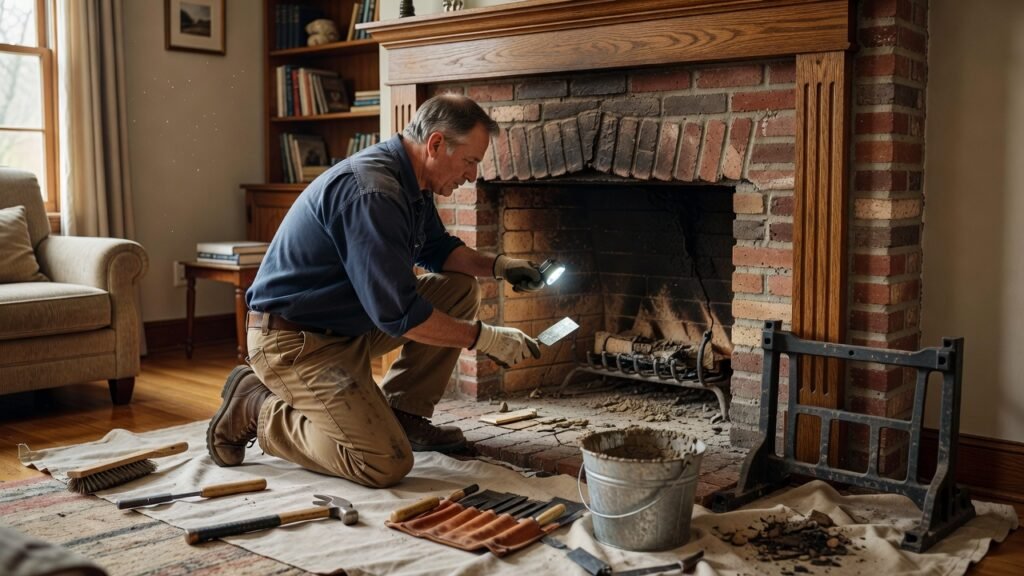
A professional rebuild can involve removing damaged firebrick or refractory components, preparing the underlying surface, and installing appropriate replacement materials.
The exact timeline depends on the extent of the damage and the construction of the fireplace. A straightforward repair may take less time than a complete reconstruction.
The important point is that a significant firebox repair should be approached as a specialized fireplace repair rather than ordinary cosmetic masonry work.
“A Level 1 Inspection Will Catch Everything”
A Level 1 inspection is useful, but it is not designed to identify every possible problem throughout a chimney system.
A Level 1 inspection generally covers readily accessible portions of the fireplace and chimney. It can be appropriate when the system has not changed and there are no known concerns requiring a more detailed inspection.
A Level 2 inspection provides a more extensive evaluation and can include video scanning of the flue.
A Level 2 inspection may be appropriate in circumstances such as:
- Buying or selling a home
- Installing or replacing a heating appliance
- Making changes to the chimney system
- After certain chimney-related events
- When a problem cannot be fully evaluated through accessible areas
This can be particularly useful in older Millburn and Livingston homes where the fireplace may have been modified by previous owners.
If a wood stove or fireplace insert was added, for example, it is worth confirming that the chimney and liner are appropriate for the current appliance.
“The Estimate Covers Everything With No Possible Changes”
A detailed estimate should give you a clear idea of what the work will cost. However, some fireplace repairs involve conditions that cannot be fully evaluated until damaged materials are removed.
For example, a contractor may uncover additional deterioration after opening a smoke chamber or removing damaged firebrick.
Older homes can contain previous repairs, moisture damage, or construction conditions that were not visible during the initial inspection.
A reputable contractor should explain these possibilities before work begins.
If the scope changes, the contractor should explain:
- What was discovered
- Why it changes the repair
- What additional work is recommended
- How the price will change
- Whether you need to approve the additional work
Be cautious of contractors who add expensive work without explaining what changed.
At the same time, an estimate that allows no possibility of adjustment is not necessarily more trustworthy. The quality of the inspection and the transparency of the contractor matter more than a promise that the first number can never change.
“Any Mason Can Handle Fireplace Repair”
Experienced masonry contractors can do excellent work on many parts of a home. Fireplace repair, however, can involve specialized considerations that go beyond ordinary exterior masonry.
A fireplace and chimney system has to work together as a combustion and ventilation system. Repairs can involve flue condition, draft, clearances, high-temperature materials, and appliance compatibility.
That is why homeowners should look for contractors with relevant chimney and fireplace training.
CSIA certification can be one useful credential to consider when hiring a chimney professional. NFI certification may also be relevant for technicians who work with specific hearth appliances.
Do not rely solely on a company’s claims. Ask what certifications the technician holds, what type of work they regularly perform, whether the company is insured, and whether written documentation is provided.
For significant repair work, photographs and written records can also be useful for future maintenance and property records.
Common Fireplace Repairs in Millburn
The type of repair depends entirely on what the inspection finds.
Common repairs can include:
Firebrick Replacement
Individual damaged bricks may sometimes be replaced when deterioration is limited.
Firebox Repair
A more severely damaged firebox may require reconstruction or replacement of refractory components.
Damper Repair or Replacement
A damaged or improperly functioning damper can affect fireplace operation and draft.
Smoke Chamber Repair
Deteriorated smoke chamber materials may require professional repair using products appropriate for high-temperature applications.
Chimney Liner Repair
If the flue liner is damaged or no longer appropriate for the appliance, professional repair or relining may be necessary.
The right repair cannot be determined from the visible portion of the fireplace alone. An inspection should come first.
What Fireplace Repair Costs in Millburn
Fireplace repair costs vary based on the type of problem, materials, accessibility, and amount of work required.
Homeowners in Millburn and surrounding Essex County communities may encounter approximate ranges such as:
- Minor firebox repairs: $300 to $700
- Full firebox rebuild: $1,200 to $2,500
- Stainless steel chimney relining: $2,000 to $4,500
- Damper replacement: $250 to $500
These figures are general ranges rather than guaranteed prices. A small repair can cost considerably less than a project involving extensive masonry or a full chimney liner replacement.
Before approving work, ask for a written estimate that explains the scope, materials, labor, and any conditions that could affect the final price.
When Should You Schedule Fireplace Repair?
Do not wait for a major failure before having a fireplace evaluated.
Consider scheduling an inspection if you notice:
- Cracks in the firebox
- Loose or deteriorating firebrick
- Smoke entering the living space
- Persistent draft problems
- A damper that does not operate correctly
- Unusual odors
- Pieces of masonry or flue material falling into the fireplace
- Visible chimney deterioration
- A heating appliance that has recently been replaced or modified
A professional inspection can help determine whether the issue is a simple repair or part of a larger chimney problem.
Get a Clear Answer Before the Heating Season
Fireplace repair is not always as simple as fixing the part that looks damaged. The visible problem can sometimes be connected to a larger issue involving the chimney liner, smoke chamber, damper, or overall fireplace system.
Maplewood Chimney Services serves Millburn, Livingston, Short Hills, Maplewood, South Orange, and surrounding Essex County communities.
If your fireplace has not been inspected recently or you have noticed signs of deterioration, contact Maplewood Chimney Services for an inspection and written estimate.
The goal is to understand exactly what is wrong, determine what needs to be repaired, and avoid paying for work that your fireplace does not actually need.
Dennis Farrell, NFI Certified
Fireplace Specialist
Expert in fireplace insert installation and chimney liner systems across northern NJ.
Related from Maplewood Chimney Services: Fireplace Cleaning in Maplewood, NJ · What Fireplace Repair Actually Costs in Millburn, NJ and What Drives t · Chimney Sweep Services in Maplewood, NJ
Areas we serve
Maplewood, NJ · Maplewood, NJ · Maplewood, NJ · Fireplace Repair Maplewood, NJ · Maplewood, NJ · Maplewood, NJ · All areas →